SaaS MVP Development
01A first release narrow enough to launch and architected wide enough to survive: real multi-tenancy, real billing, and only the features that prove the thesis.
- Multi-Tenant
- Billing
- Fast Launch
Asematic delivers custom SaaS development services in India for founders and operators building B2B platforms. Multi-tenant from the first migration, billed by subscription from the first release, and instrumented so you can see churn coming.
Platform budget
The thresholds the platform is measured against, load-tested before a paying tenant arrives.
The demo works. The first customer is delighted. Then the tenth arrives, and the decisions made in week two start charging interest. This is where platforms leak, and what replaces it.
What it costs you
A single-tenant app you now have to clone per customer
Tenant identity carried through every query, migration and background job from day one, so onboarding customer fifty costs the same as customer five.
What it costs you
Invoices raised by hand in a spreadsheet
Plans, seats, usage metering, proration, dunning and tax handled through Stripe or Razorpay, with entitlements enforced in the application rather than tracked on trust.
What it costs you
One data leak away from losing the account
Row-level security or schema separation, scoped API tokens, encrypted secrets and an audit log that answers who touched what — the evidence enterprise procurement asks for.
What it costs you
Churn you only notice on the renewal date
Activation, feature adoption, seat utilisation and cohort retention instrumented as the features ship, so a customer going quiet surfaces weeks before they cancel.
What it costs you
A staging deploy that takes an afternoon and a prayer
Automated tests, preview environments per branch, zero-downtime deploys and backward-compatible migrations, so shipping on a Friday stops being a risk decision.
What it costs you
Infrastructure spend rising faster than revenue
Query and storage costs attributed to tenants, caching and queue strategy chosen against real usage, so your gross margin holds as the customer count climbs.
An MVP and an enterprise-ready platform are different problems. They get the same tenancy discipline, the same access controls and the same instrumentation.
A first release narrow enough to launch and architected wide enough to survive: real multi-tenancy, real billing, and only the features that prove the thesis.
Workspaces, granular roles, SSO, invitations and admin tooling — the organisational plumbing every business buyer expects before they will sign.
Plan design, seat and usage metering, upgrades and proration, dunning and invoicing, with entitlements enforced server-side across every endpoint.
Retrieval over tenant-scoped data, assistive workflows and generated summaries built with prompt versioning, evaluation and per-tenant cost controls.
Per-tenant branding, custom domains, configurable feature flags and partner-level administration for platforms sold through a reseller channel.
Turning a single-tenant application or an ageing monolith into a platform: tenancy retrofit, data migration and a decomposition plan that ships incrementally.
Tenancy is close to impossible to change once customers are live, so it is chosen deliberately against your buyers and your compliance obligations. Here is the trade-off, in full.
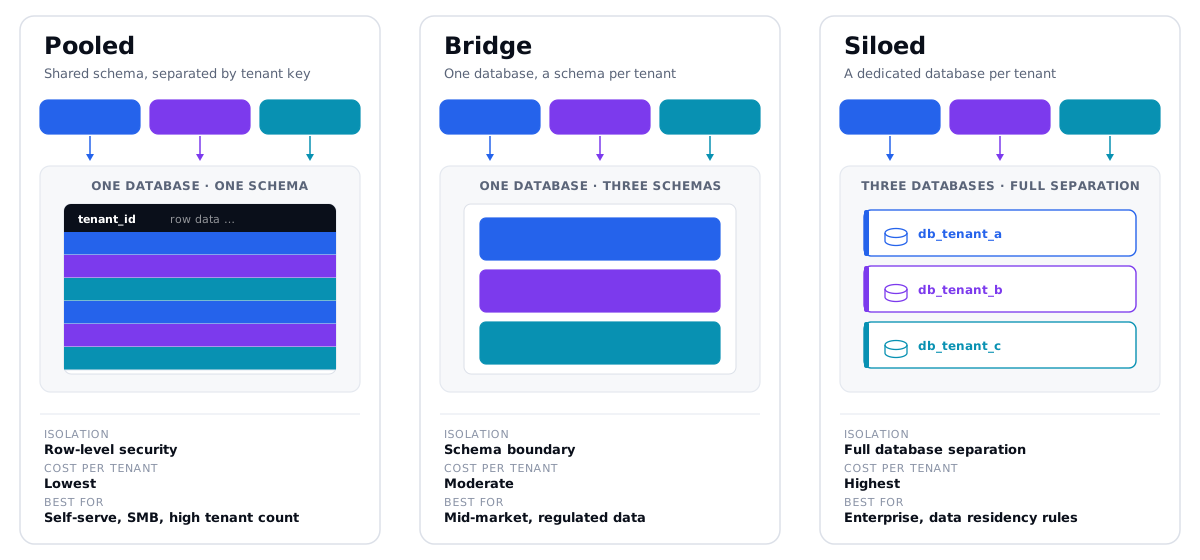
Choose for volume and margin
Every tenant shares tables, separated by a tenant key and row-level security. Cheapest to run and simplest to migrate, provided isolation is enforced in the data layer.
Choose when customers ask hard questions
One database, a schema per tenant. Stronger separation and per-tenant restore, at the cost of migrations that must run across every schema.
Choose when the contract demands it
A dedicated database, and sometimes dedicated infrastructure, per tenant. Required for data residency and the largest enterprise agreements; priced accordingly.
These fifteen items are not line-items on a quote. They ship with every platform we build, on every engagement model. A SaaS product missing any one of them will fail either a security review or a growth curve.
We pick the stack per project, from a short list we know deeply. Nothing is on this page because it trends — each tool is here because it measurably moves response time, infrastructure cost or the speed of the next release.
Tenancy, authentication and billing are built before product features, so everything that follows inherits isolation and entitlements. Each stage closes with a named deliverable you review.
We pin down the jobs your first ten customers are paying for, then choose the tenancy model against that reality. The data model, roles and billing shape are settled before anything is built.
Deliverables
Onboarding, workspace setup, the core loop and the admin surface designed as one system, with empty, loading and error states specified rather than improvised later.
Deliverables
Authentication, tenancy, role-based access, billing and the deployment pipeline are built first, so every feature after this inherits isolation and entitlements for free.
Deliverables
Product features ship in two-week sprints against the foundations, each one load-tested and instrumented, with a demo environment you can put in front of design partners.
Deliverables
We ship to production with monitoring, alerting and restore procedures rehearsed, then work from activation and retention data on a fixed cadence rather than from opinion.
Deliverables
Scope determines the model, not the other way round. We will tell you in discovery which of these actually fits the stage your product is at.
A first version with a funding or launch deadline
Scope, milestones and cost agreed upfront against a written specification. Best when the thesis is clear and you need a credible platform in front of customers by a date.
A live platform that has to keep shipping
A monthly block of design and engineering spent on new features, scale work, experiments and technical debt, prioritised with you against retention and revenue data.
A roadmap that needs its own engineering crew
Engineers, a designer and a delivery lead assigned full time, working inside your tools, stand-ups and release process as your product team rather than an agency.
Every quote is fixed against a written specification, so the number you approve is the number you pay.
The questions founders and product leaders actually ask before commissioning SaaS development work, with real answers rather than a sales line.
Cost tracks architecture and integration depth rather than screen count. A focused MVP on a pooled tenancy model sits in a very different bracket to an enterprise platform with SSO, usage-based billing and data-residency rules. The engineering and compliance surface are simply larger. We scope in discovery and quote a fixed figure against a written specification, so there is no open-ended billing.
A production-ready first release typically runs fourteen to fifteen weeks. That breaks down as two weeks of product and architecture discovery, two weeks of design, four weeks building the tenancy, auth and billing foundations, then six weeks of feature work and hardening. Platforms needing SSO, complex usage metering or migration from an existing system extend that.
Multi-tenancy is how one running application serves many customers while keeping their data separate. It matters because it is extremely expensive to retrofit. A single-tenant app cloned per customer means every deployment, migration and bug fix multiplies by your customer count, and margins collapse as you grow. We decide the tenancy model — pooled, bridge or siloed — during discovery, based on your buyers and your compliance obligations rather than on a default.
Yes. We integrate Stripe, Razorpay, Paddle or Chargebee, then build the parts that sit around them. That means plan and seat modelling, usage metering accurate enough to invoice from, upgrades with proration, dunning for failed payments, invoicing and tax handling. Entitlements are enforced server-side on every endpoint, so a downgraded plan actually loses access rather than merely being asked to.
Yes. Enterprise buyers ask a predictable set of questions. They want single sign-on with SAML, SCIM user provisioning, granular role-based access, an audit log, data residency, an uptime commitment and a security review. We build those capabilities and prepare the documentation that procurement and security teams request, so a large deal is not blocked by the platform.
Yes, and it is a common engagement. We audit the current schema and deployment model, design the tenancy retrofit, then plan a migration that runs incrementally rather than as one high-risk cutover. Usually that means introducing tenant context alongside the existing model, backfilling data, and switching reads over once parity is verified.
Yes. We deploy to your own AWS, Vercel or Cloudflare account so the infrastructure stays yours, and set up monitoring, alerting, log aggregation and rehearsed restore procedures. Ongoing cover includes security patching, dependency upgrades, incident response and performance work, either as a maintenance plan or as a product retainer that also funds new features.
You do. The repository, the source code, the designs and the infrastructure accounts are yours from the first commit. Work happens in your version control rather than being handed over at the end. We provide architecture documentation and a handover walkthrough so another team could pick the platform up without us.
The product earns the subscription. What acquires the user and what your own team runs on decide whether the unit economics work. These are the pieces that usually sit either side of it.
Send us the thesis, or the application you already have and the ceiling it has hit. You will get a technical read on the tenancy model, the scope and the realistic timeline — before any commitment.