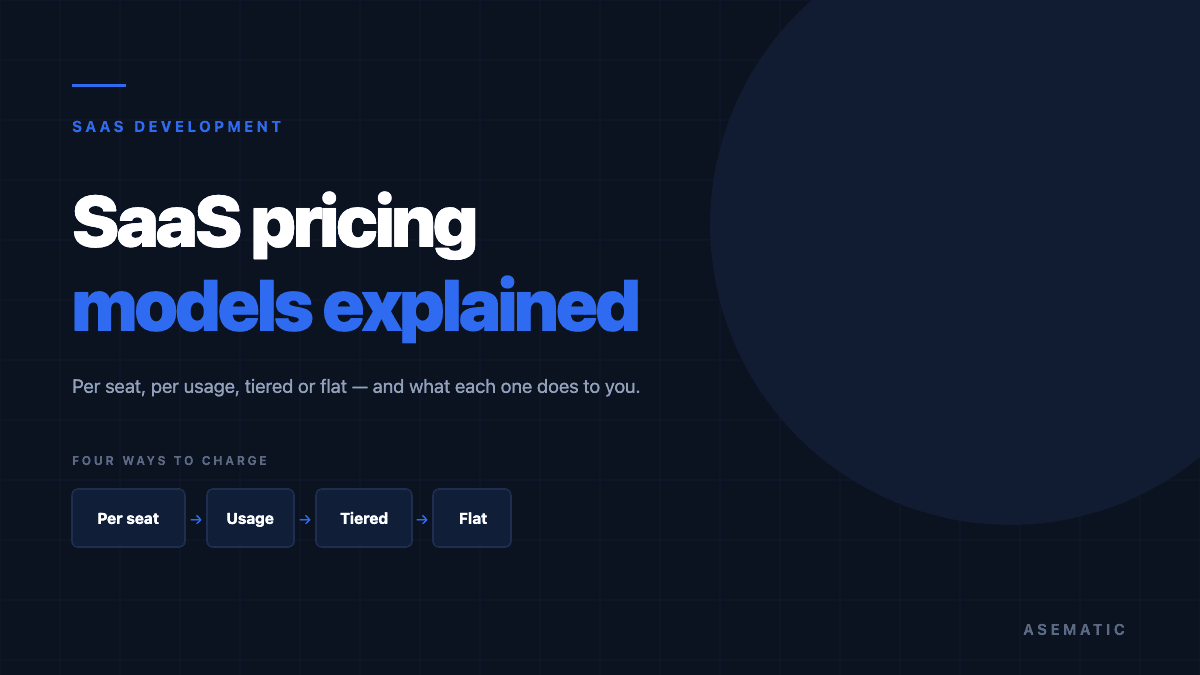
Pricing is not a number you pick at the end. It decides which customers you attract, what your support load looks like, and which features get built — because the model determines what a customer is paying you more for.
The four models, and what each one really does
Per seat
Charge per user per month. Simple to explain, predictable to forecast, and the default in B2B for good reason.
The problem is structural: you are charging customers for adopting your product more widely. Customers respond rationally by rationing seats, sharing credentials, and keeping the product confined to one team. All three reduce exactly the stickiness that makes SaaS valuable.
Works when value genuinely scales per person — a sales CRM where each rep manages their own pipeline. Works badly when the value is in the system rather than the seats, such as an inventory platform where the warehouse team needs occasional access.
Usage-based
Charge per unit consumed — API calls, transactions, messages, gigabytes. It aligns your revenue with the value delivered, and small customers can start cheaply.
The cost is predictability, on both sides. Your revenue becomes harder to forecast, and your customer cannot budget confidently — which slows enterprise deals, where an unpredictable line item is a procurement problem regardless of the average.
Works when consumption correlates tightly with the customer's own revenue. Works badly when usage is spiky for reasons outside the customer's control, because the bill arrives as a punishment for a bad month.
Tiered
Package features into two or three plans at fixed prices. Customers self-select, the upgrade path is visible, and revenue is predictable.
The difficulty is that tier design is a product decision disguised as a pricing one. Every feature you put behind the higher tier is a feature you have decided most customers should not have — and if you place the wrong one there, adoption stalls in a way that is very hard to diagnose from a revenue chart.
Works when customer segments have genuinely different needs. Works badly when tiers are drawn by arbitrary limits that irritate rather than by capability that matters.
Flat rate
One price, everything included. Radically simple to sell, to explain and to build billing for.
It leaves money on the table at the top and prices out the bottom. But for a focused product with a narrow customer profile it is frequently the right answer, and the operational saving is real — no seat counting, no usage metering, no upgrade conversations.
The question that picks the model: what does a customer get more of, as they get more value from you? More people using it → per seat. More transactions through it → usage. More capability → tiered. Nothing in particular, they just use it → flat.
What most products actually run
A hybrid: two or three tiers, each with a seat allowance and an overage, plus usage pricing on anything with a genuine marginal cost such as SMS or storage. That gives the customer a predictable base and gives you growth that does not require a renegotiation.
Whatever you choose, the billing system has to implement it correctly on day one. Proration, mid-cycle upgrades, failed payments, refunds and tax are where subscription billing actually gets hard, and retrofitting them is considerably worse than building them — a point worth settling before the first line of billing code is written.
Indian-market specifics worth planning for
- GST at 18 per cent applies to SaaS. Decide early whether displayed prices include or exclude it, state it plainly, and generate compliant invoices automatically — B2B customers need them to claim input credit and will chase you until they arrive.
- Recurring card mandates in India operate under the RBI e-mandate framework, with limits and authentication requirements that affect how auto-renewal behaves. Design for a mandate that needs re-authorisation rather than assuming a card charges silently forever.
- UPI is the preferred rail for smaller customers, and UPI AutoPay handles recurring collection. A checkout without it will lose sign-ups that had nothing to do with your price.
- Annual billing carries more weight in the Indian SMB market than in the US, where monthly is the norm. A meaningful annual discount improves both cash position and retention.
Three mistakes that are expensive to reverse
- Pricing from your costs. Costs set your floor, not your price. The price is set by what the outcome is worth to the customer, which is usually a different number and often a larger one.
- Too many tiers. Five plans is a decision the customer cannot make, so they postpone it. Three is plenty and two is often better.
- A free tier with no path out of it. Free is a marketing cost that must convert. If the free tier is genuinely sufficient for your core use case, most users will stay there permanently and you have bought a support burden.
Changing pricing later
You will. Plan for it so the change is boring:
- Grandfather existing customers on their current terms. The goodwill is worth more than the delta.
- Apply the new pricing to new customers only, and watch conversion for a quarter before touching anyone else.
- If you must move existing customers, give a full billing cycle of notice and make the new plan visibly better, not merely dearer.
Most of the damage from repricing comes from surprise, not from the number. Customers who find out from an unexpected invoice churn at rates that have very little to do with the increase.
Designing pricing for a product you are building? We work through the model, the billing mechanics and the Indian tax and mandate handling as part of SaaS development — before the architecture makes the decision for you. Talk it through with us.