Website quotes in India range from ₹15,000 to ₹15,00,000 for briefs that sound identical over the phone. That is not because the market is irrational. It is because the word website describes a five-page company profile and a hundred-page platform with equal accuracy.
This guide sets out what the bands actually buy in 2026, the four variables that move a quote more than anything else, and the questions that expose whether two proposals are comparable. Every figure below is a market range, not our price list — what we charge is quoted against a written scope after we understand the brief.
What each price band actually buys
The honest way to read a website quote is by what it includes, not by the number on the front page. These are the bands as they exist in India in 2026.
| Type | Typical range | What it includes |
|---|---|---|
| Template site | ₹15,000 – ₹40,000 | A purchased theme, your logo and copy dropped in, five to eight pages, a contact form. No custom design, content supplied by you. |
| Business website | ₹40,000 – ₹1,50,000 | Custom design against your brand, eight to twenty pages, CMS so you can edit, mobile layouts drawn rather than inherited, basic SEO groundwork, analytics. |
| Content-managed site | ₹1,50,000 – ₹4,00,000 | The above plus structured content types, a blog, multilingual or multi-location handling, form routing into a CRM, and a design system rather than a set of pages. |
| E-commerce | ₹50,000 – ₹6,00,000 | Catalogue, cart, payment gateway, order and inventory handling, GST-correct invoicing, shipping integration. Scales with SKU count and fulfilment complexity. |
| Web application | ₹50,000 upward | Accounts, roles, data the user creates and returns to, business logic. This is software development wearing a website's clothes, and it is priced accordingly. If it needs to live on a phone instead, app budgets work differently again. |
Most Indian businesses looking for a website need the second or third band. The first is a placeholder. The last two are different products that happen to run in a browser.
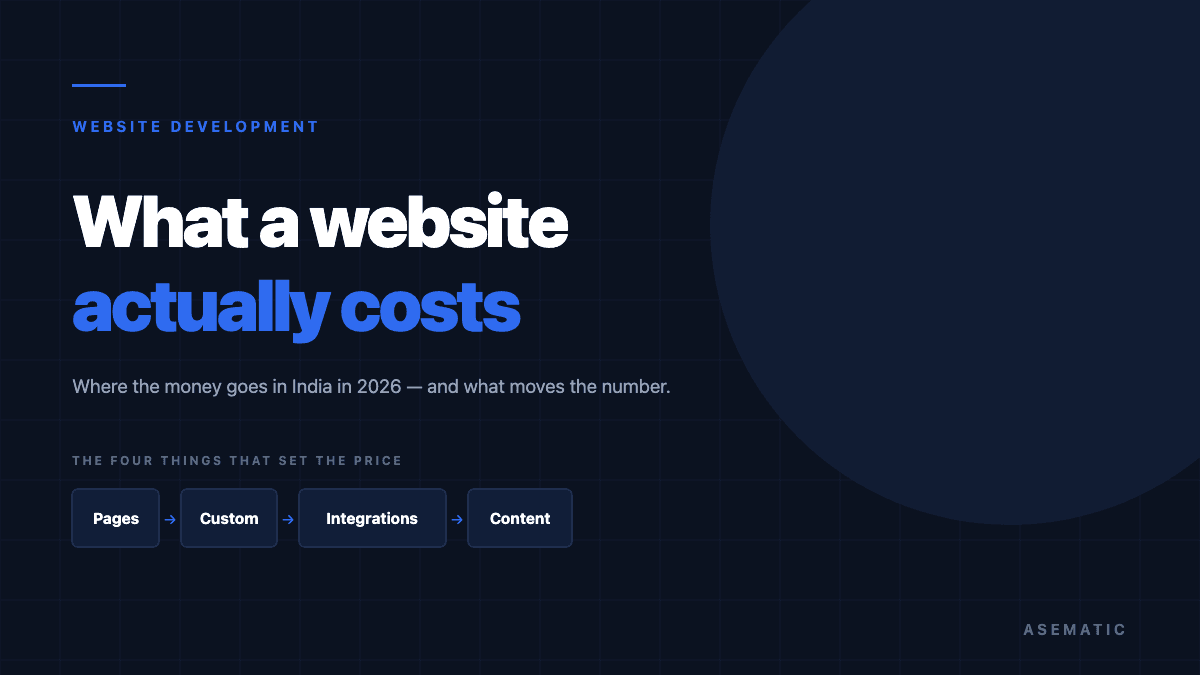
The four things that actually move the number
1. Page count — but not the way you think
Ten pages do not cost twice five. What costs is the number of distinct layouts. Fifteen pages that reuse four layouts is a smaller job than six pages that each need their own. When a quote asks for a page count, what it is really asking is how many templates have to be designed, built and made to work on a phone.
Before you ask for a quote, sort your pages into groups that can look the same. The list gets shorter and the quote gets cheaper.
2. How much design is genuinely custom
There is a real gap between a theme configured to your colours and an interface designed for your business. Custom design costs more and earns it when the site has to carry a brand, explain something complicated, or convert traffic you paid for. It does not earn it when the site exists so people can find your phone number.
The middle path most businesses want: a custom home page and a custom template for the pages that sell, with interior pages on a shared layout. That concentrates the design budget where visitors actually decide.
3. Integrations
Every system the site has to talk to is a separate piece of work with its own failure modes. A contact form that emails you is trivial. A form that creates a lead in your CRM, assigns it by territory, and triggers a WhatsApp acknowledgement is three integrations and a fortnight.
Common ones and roughly what they add:
- Payment gateway — ₹15,000 to ₹40,000 including testing against live conditions, more if you need subscriptions rather than one-off payments
- CRM or ERP sync — ₹25,000 upward, depending entirely on whether the system has a usable API or you are scraping a spreadsheet
- WhatsApp Business API — ₹20,000 upward plus per-message costs you pay to the provider, not to us
- Booking or scheduling — ₹30,000 upward, because availability logic is harder than it looks
4. Who writes the content
This is the variable that delays more projects than any other, and the one most quotes leave silent. If you supply finished copy and images, the build runs to schedule. If the agency writes it, add ₹1,500 to ₹4,000 per page and several weeks. If nobody has decided, the project stalls at eighty per cent complete while everyone waits for the About page.
Before you approve any quote, get these five answers in writing.
- How many pages, and how many distinct layouts among them
- Who writes the content, and how many revision rounds are included
- What the site is built on, and whether you can edit it without the agency
- Who owns the code and the design files when the invoice is paid
- What year two costs — hosting, domain, updates, support
The costs that appear after launch
A website is not a one-off purchase, and a quote that implies otherwise is incomplete. Budget for the running costs from the start:
| Item | Typical annual cost |
|---|---|
| Domain | ₹800 – ₹1,500 |
| Hosting | ₹3,000 – ₹25,000 depending on traffic and whether it is shared or dedicated |
| SSL certificate | Free with most hosts; ₹3,000 – ₹10,000 if you need an organisation-validated one |
| Maintenance and updates | ₹12,000 – ₹60,000, and genuinely necessary on any CMS |
| Content changes | Zero if you can edit it yourself, which is the argument for a CMS |
Where the money is usually wasted
Three patterns account for most of the regret we hear about:
- Paying for pages nobody reads. A twenty-page site where four pages take ninety per cent of the traffic means sixteen pages were designed, built and are now maintained for nothing. Check your analytics before you commission a rebuild at the same size.
- Buying a CMS nobody uses. The content management system is justified by the editing you will do. If the last site went three years without an edit, the CMS was a cost, not a capability.
- Launching without indexable markup. A site that looks finished but cannot be crawled properly earns nothing from search. This is cheap to get right during the build and expensive to retrofit — see our note on the technical SEO checklist.
How to compare two quotes honestly
Put both proposals side by side and normalise them on five axes: page and layout count, content ownership, revision rounds, integrations, and post-launch cost for year one and year two. Most of the time the cheaper quote becomes the more expensive one at this point, or the gap closes to something defensible.
If a proposal will not state those five things, that is itself the answer. A scope that cannot be written down cannot be held to.
Working out a realistic budget? Send us the brief and we will tell you which band it falls in and why — including when the honest answer is that you need less than you were about to buy. Start a conversation or read how we scope website builds.