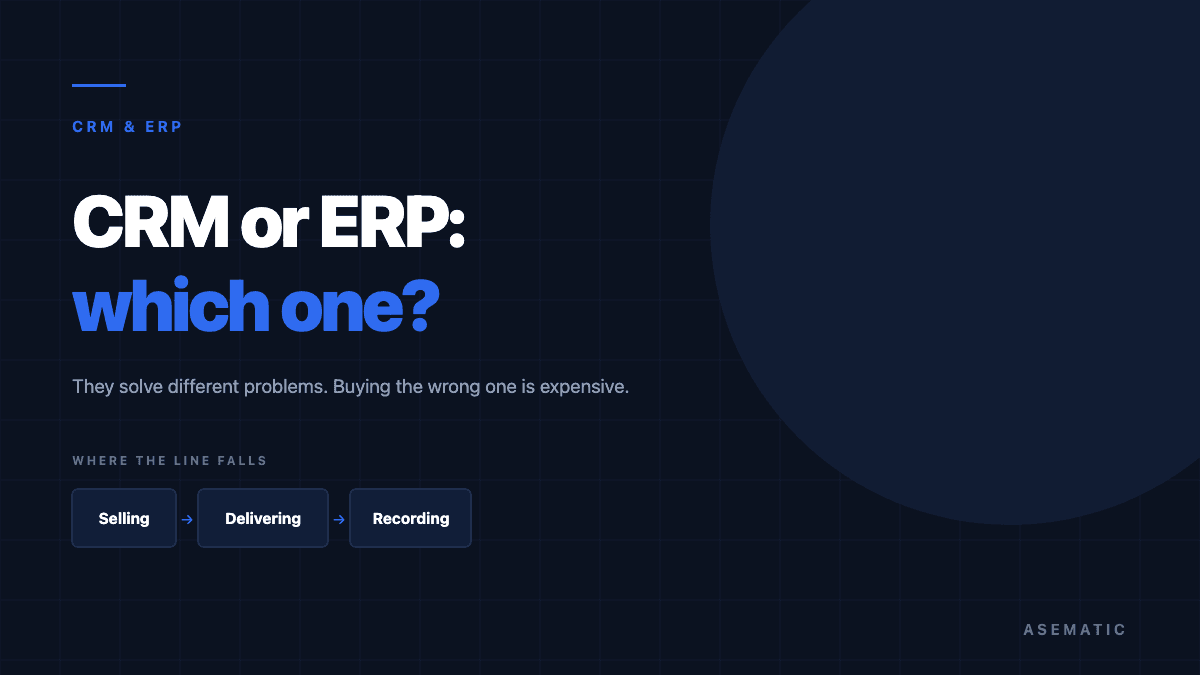
The distinction is simpler than the acronyms suggest. A CRM helps you win the work. An ERP helps you deliver it and account for it. Almost every expensive software mistake we are asked to repair starts with buying one to do the other's job.
Where the line actually falls
| Question | CRM | ERP |
|---|---|---|
| What it manages | The pipeline to a signed order | Everything after the order is signed |
| Core records | Lead, contact, opportunity, quote | Item, purchase order, invoice, ledger |
| Who lives in it | Sales, marketing, support | Operations, stores, accounts, HR |
| Question it answers | What will we close this month? | What did it cost and did we get paid? |
| Pain it removes | Lost enquiries, forgotten follow-ups | Stockouts, unbilled work, manual reconciliation |
| Typical adoption | Weeks | Months |
They meet at exactly one point: the confirmed order. The CRM produces it; the ERP consumes it. When people talk about integrating the two, that handover is almost always what they mean.
Buy a CRM first if these are true
- You cannot say, without asking someone, how many live enquiries exist and what stage each is at
- Enquiries arrive across WhatsApp, phone, email and a website form, and no two land in the same place
- Follow-ups depend on someone remembering rather than on anything automated
- When a salesperson leaves, their pipeline leaves with them
- You cannot tell which marketing spend produced which revenue
These are conversion problems, and they are the cheapest expensive problem to fix. A CRM is adopted in weeks because the people who use it see the benefit personally — their own follow-ups stop slipping.
Buy an ERP first if these are true
- You have lost a sale to a stockout while the same item sat in another location
- Work gets delivered and invoiced late, or occasionally not at all
- Month-end close takes a week and involves reconciling spreadsheets against each other
- You cannot cost a job accurately until well after it is finished
- Compliance — GST returns, statutory reporting — is assembled by hand under deadline
These are margin and risk problems. They cost more than the CRM problems and they are harder to fix, because an ERP touches departments that do not currently agree on definitions.
The diagnostic question. Ask where the money is actually leaking. If revenue is being lost before the order, it is a CRM problem. If it is being lost after the order — in stock, in unbilled work, in errors, in reconciliation — it is an ERP problem. Businesses usually know the answer immediately and then talk themselves out of it because the other system is easier to buy.
When you genuinely need both
Once you are running both a real pipeline and real operations, the handover between them becomes the problem. Symptoms:
- Someone re-keys a confirmed order from the CRM into the ERP, and the two drift
- Sales promise delivery dates without seeing stock or capacity
- Finance cannot connect an invoice back to the deal that created it
- Reporting requires exporting both systems into a spreadsheet to answer one question
At that point the choice is two integrated systems or one platform covering both. For most small and mid-sized Indian businesses, one system on one data model is the better answer: a customer, an order and an invoice become the same records rather than three copies kept in sync by a nightly job that fails quietly.
Specialist tools win when one part of your operation is genuinely unusual — a manufacturing process with real production planning, or a sales motion that needs capabilities an all-in-one will never prioritise. Whole sectors work this way: a school management platform or a restaurant POS carries rules a general system would take years to learn.
What each realistically costs in India
| Option | Typical cost | Time to useful |
|---|---|---|
| Off-the-shelf CRM | ₹800 – ₹4,000 per user per month | 2 – 6 weeks |
| Off-the-shelf ERP | ₹2,000 – ₹8,000 per user per month, plus implementation | 3 – 9 months |
| Custom CRM | ₹3,00,000 – ₹12,00,000 one-off | 6 – 12 weeks |
| Custom CRM + ERP | ₹8,00,000 upward | 4 – 8 months |
Per-user pricing looks cheaper until you count the users. A twenty-person team on a ₹3,000 seat is ₹7.2 lakh a year, every year, and the price rises as you hire. That arithmetic is the usual reason businesses move to a system they own — but it only holds if your process is genuinely specific. If it is standard, configuring a product beats paying to rediscover the requirements.
The mistake that costs the most
Buying an ERP to fix a sales problem. It happens because ERPs are sold as complete business systems, and the CRM module is included, so it looks like the bigger purchase solves both. In practice the sales team gets a CRM designed by people who think in ledgers, refuses to use it, and the pipeline goes back into a spreadsheet — now alongside an expensive system nobody trusts.
The reverse mistake is cheaper but real: stretching a CRM into operations with custom fields until it holds your stock levels badly.
Not sure which problem you have? Describe where work currently gets stuck and we will tell you which system addresses it — including when the answer is that you need neither yet, and a shared spreadsheet with agreed rules will hold for another year. Talk to us, or see how we build CRM and ERP systems.