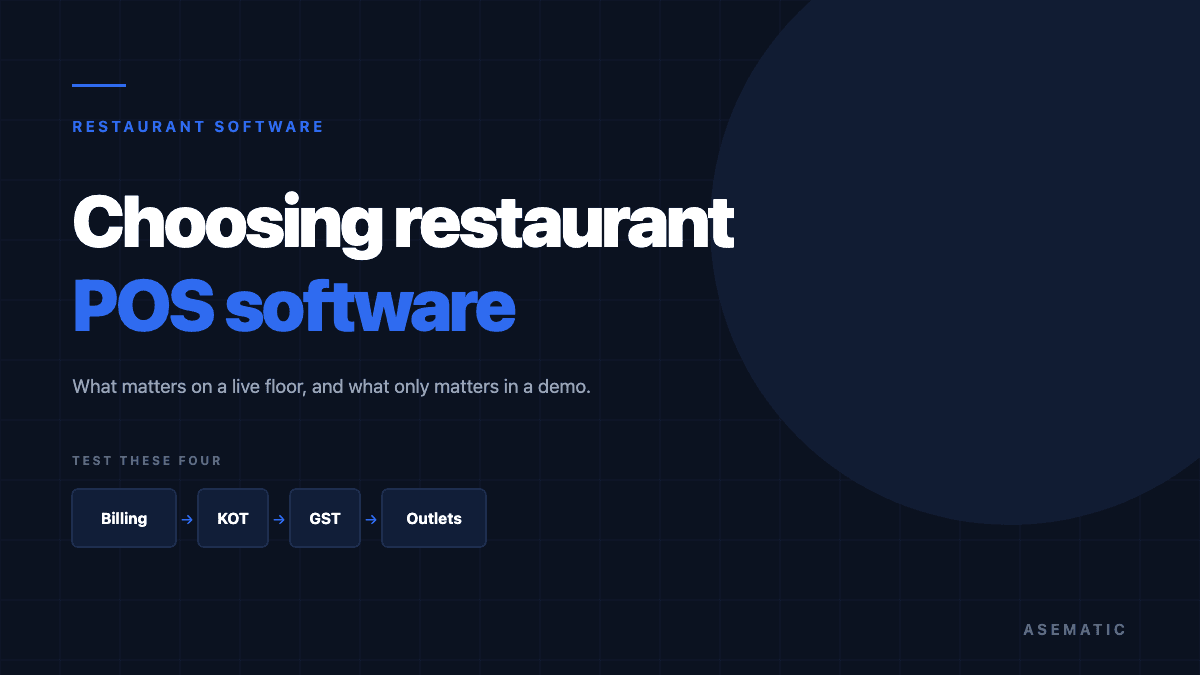
Restaurant software is judged in a demo and lived with during a Saturday dinner rush. Those are very different tests, and most of what gets compared on a feature grid turns out not to matter while what gets skipped does.
The five things that decide it
1. Billing speed at the counter
Count the taps. From a table's order to a printed bill, a good system takes a handful of actions; a bad one takes twenty and a search box. During a rush that difference is the queue at the door.
Test this specifically: ask to bill a table of six with three modifiers, one item removed after ordering, and a split payment. Time it. That is your Saturday.
2. Kitchen routing that nobody re-keys
An order taken at the table must reach the right station — kitchen, bar, dessert — with modifiers and instructions attached, without anyone writing it again. Whether that arrives as a printed ticket or on a kitchen display screen matters less than whether it arrives complete and in the right place.
The failure to look for: items that reach the wrong station, or modifiers that print on the bill but not on the ticket. Both produce the same result at the pass, and both are common.
3. GST correctness
Restaurant GST in India has enough real complexity — different rates by service type, composition scheme, place of supply — that "we handle GST" deserves specific questions. Ask to see a bill with mixed-rate items, and ask what return-ready reports the system produces. Your accountant should be able to work from the output rather than rebuild it.
4. Offline behaviour
Billing and kitchen tickets must keep working when the internet drops, because service cannot stop while a line is repaired. The question that separates products is what happens on reconnection: do offline orders synchronise automatically, without duplicates and without loss?
Reporting and multi-outlet dashboards legitimately need connectivity. Service does not, and a system that stops taking orders during an outage is not fit for an Indian restaurant.
5. Multi-outlet control, if you have or want outlets
One outlet can be run from a good till. Two or more is where software earns its keep — and where most cheap systems stop. What to check: whether menus and prices push centrally with per-outlet overrides, whether sales are comparable across branches from one screen, and whether an outlet manager can be restricted to their own branch.
If you might open a second outlet in two years, ask what that costs now. Discovering that multi-outlet is a different product at a different price is an unpleasant surprise at the moment of expansion.
The demo to insist on. Load your real menu — all of it, including the awkward items with variants and time-based availability — and run one full table through: order, add an item mid-meal, send to kitchen, split the bill, pay part by UPI and part by cash, then print the GST invoice. Anything that cannot do that cleanly will be worked around within a fortnight, and a system your staff work around is not in use.
What matters less than the sales deck suggests
- The number of reports. Forty reports nobody opens is not better than six that answer the questions you actually ask. Ask which ones an owner opens daily.
- Loyalty programmes, at first. Genuinely valuable once service is running smoothly; irrelevant if billing is slow. Sequence matters.
- AI features. Demand forecasting on a single outlet with eight months of data is decoration — automation pays where volume is high and rules are clear, which this is not. Revisit at scale.
- Hardware bundles. Commodity tablets and thermal printers work fine. Proprietary hardware ties you to one vendor's replacement pricing for years.
Pricing and the questions to ask
Indian restaurant platforms charge per outlet, per terminal, or per user — three of the standard subscription models, with very different consequences as you grow. Per outlet is almost always better for the operator — it lets you add a second billing screen or a captain's tablet without the bill moving, which is exactly what you want to be free to do.
Get these answers before signing:
- What does a second terminal in the same outlet cost?
- What does a second outlet cost?
- Are staff logins capped?
- Is the payment gateway charge separate from the software fee, and at what rate?
- Are SMS or WhatsApp messages billed on top?
- What is the support response time, in writing, and does it cover Saturday night?
That last one is not a joke. A system with weekday-only support is a system without support, because everything that breaks expensively breaks at dinner service.
Getting your data out
Your sales history is the most valuable thing the system holds — it is what any future pricing, costing or forecasting decision depends on. Confirm before signing that you can export sales history, the menu and customer records in standard formats, at any time, without a fee. Those customer records also bring data protection obligations with them.
A vendor who makes export difficult is relying on that difficulty. It is worth more than a small discount.
A sensible order of adoption
- Billing and kitchen tickets first. Get service running cleanly before anything else.
- Payments and reconciliation next, so the day closes itself.
- Then reporting, once there is a fortnight of trustworthy data to report on.
- Then loyalty and QR ordering, which earn their keep only when the basics are solid.
Attempting all four in week one is how staff end up back on a notepad.
Comparing systems? Beanrow is our platform for restaurants and multi-outlet chains, and we will run the full-table demo above on your own menu before you commit to anything. See how we approach hospitality technology or ask for a walkthrough.