Most institutions evaluate school management software by comparing feature lists, then discover in month three that the module they never tested is the one their office lives in. The features that matter are the ones your staff touch daily, and there are about five of them.
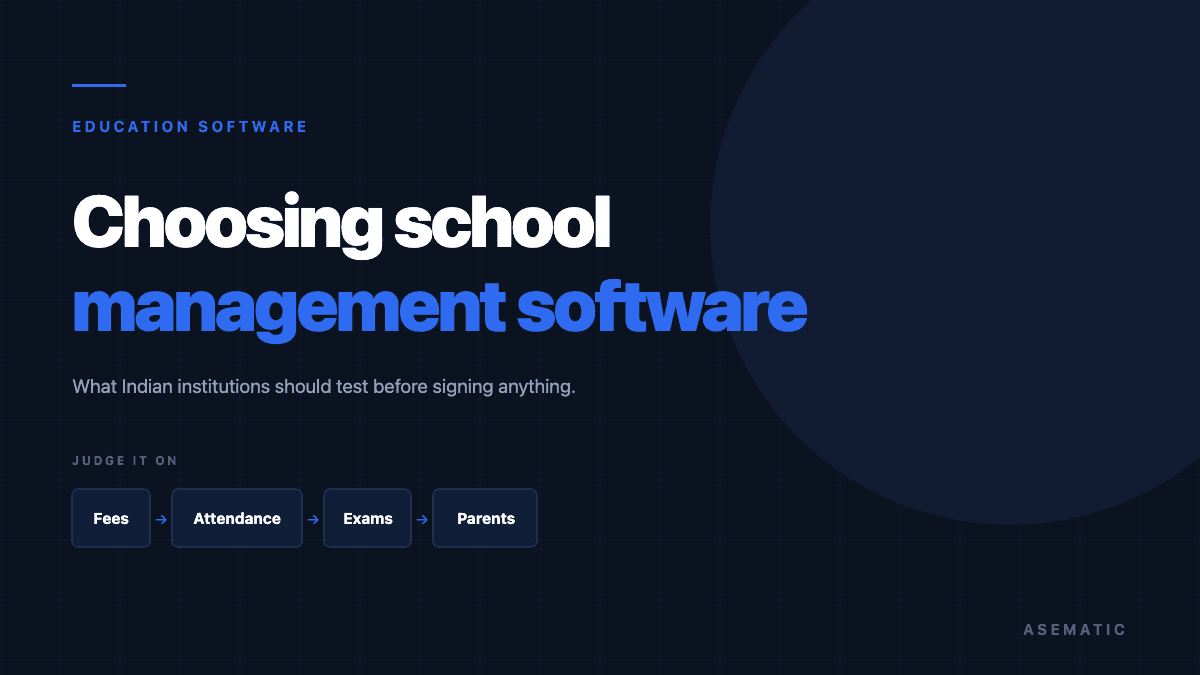
The five modules that carry the workload
Whatever else a platform offers, these are where the administrative hours actually go:
- Admissions — enquiry capture with source, follow-up stages, document collection, and conversion into a student record without anyone retyping the same details
- Attendance — class and subject-wise marking on a phone or a browser, absence patterns surfaced automatically, and parents notified the same morning rather than at term end
- Fees — structured heads, instalments and concessions, online collection, automatic receipts, and a live outstanding list the office can work from
- Examinations — your board's grading scheme, subject-wise mark entry, and report cards in your own format with no manual totalling
- Parent communication — attendance, fees, timetable and results visible on a phone, plus announcements to a class or the whole institution
Library, hostel, transport, inventory and payroll all matter, but they should not decide the purchase. If the five above are weak, the extras will not save you.
What to actually test in a demo
Vendors demonstrate the happy path. Insist on the awkward ones — these are the cases that consume your office:
| Ask them to show | What it reveals |
|---|---|
| A mid-term admission with fees pro-rated | Whether the fee engine handles anything other than a clean April start |
| A sibling concession across two classes | Whether concessions are a real structure or a manual adjustment |
| A student who changes section in August | Whether history follows the student or breaks |
| A part payment, then a refund | Whether the receipt and ledger stay correct |
| Report cards in your exact format | Whether "customisable" means configuration or a change request |
| Attendance marked on a phone, offline | Whether teachers can actually use it in a classroom |
| A parent's view of their own child only | Whether permissions are real or a filter |
Ask them to do it live, on the call, with data you supply. A vendor who needs to come back to you on three of these has told you something useful.
The single best demo request: send a spreadsheet of fifty real student records, with the messiness left in — missing phone numbers, duplicate names, inconsistent date formats — and ask them to load it and show you the fee ledger. How they handle imperfect data is how your migration will go.
Migration is the project, not a step in it
Most implementations that go badly go badly here. The transfer is not the hard part; the data is. Expect duplicates, students recorded under two names, fee heads that changed mid-year, and historical results in a format nobody documented.
Insist on this sequence:
- Audit first. The vendor looks at your actual export and tells you what is wrong with it before quoting a timeline.
- Load into staging. Never straight into production.
- Reconcile against your own totals — student strength by class, total outstanding fees, last term's results. The numbers must agree before anyone trades on them.
- Parallel run for one cycle. Old and new side by side until both agree.
If a vendor proposes go-live without a reconciliation step, that is a reason to walk away. Discovering in November that the outstanding fee figure is wrong is a far more expensive conversation than a fortnight of checking.
Pricing, and the questions that expose the real number
Indian platforms price either per student per month or as a flat annual licence — the same per-seat versus flat-rate trade-off that runs through all subscription software. Neither is inherently better — per student suits institutions wanting cost to track enrolment, flat suits larger institutions where per-student arithmetic stops being favourable.
What matters more is what the figure covers. Ask directly:
- Is data migration included, or quoted separately once they have seen the data?
- Is staff training included, and for how many sessions?
- Is parent access included, or priced per parent?
- Are SMS and WhatsApp messages included, or billed per message on top?
- What does support cost, and what response time is written down?
- What does year two cost, and what governs an increase?
Messaging is the line item that most often surprises institutions, because fee reminders and absence alerts at scale are a lot of messages.
Three contract terms worth fixing before you sign
- Data export. You must be able to export everything — students, fees, attendance, results, staff — in standard formats, at any time, without a fee. Get it in writing. This is the term that determines whether you ever have a choice again.
- Data protection. You are holding minors' personal data, which makes you a data fiduciary under the DPDP Act with obligations around consent, retention and breach notification. Ask what the vendor's role is, what their security posture is, and what happens to your data when you leave. Our DPDP checklist covers what that means in practice.
- Exit terms. Notice period, what happens to data after cancellation, and for how long it stays retrievable.
Configure or build?
For the overwhelming majority of schools and colleges, configuring an existing platform is the right answer. Fee structures, grading schemes and attendance rules vary between institutions, but not in ways a well-built product cannot be configured to handle — and paying to rediscover requirements that are already solved is a poor use of a budget.
Building makes sense when something about the institution is genuinely unusual and central: an assessment model no product supports, or a multi-campus structure with rules that cut across everything. That is a custom system conversation, and it should start with someone telling you honestly that you probably do not need one.
Evaluating options? Campustrue is our platform for Indian schools and colleges, and we will run the awkward demo cases above on your own sample data before you commit to anything. See how we approach education technology or ask for a walkthrough.